Powered By Blogger

Friday, June 17, 2011

Oh, Ye'll take the highroad

The Highlands of Scotland


It's a short plane ride from Stockholm, just under two hours and you can find yourself in the land of haggish and multicolored plaids.  I've visited the Highlands twice before, and each time I felt a sense of awe at the complete 'wildness' of the land.  Two years ago, I took this photo while I was hiking along the coastal paths -in the distance is the Isle of Skye.  Last year, I spent time  exploring hidden castle ruins in the Trossachs, and in a few days time, I shall be venturing into the Cairgorms in search of the Scottish Wildcats.

A Harp Still Resonates in an Ancient Grand Hall


Scotland, for me, is a very musical country, and if one stands very still in a quiet place for any length of time, the melodies of olde can still be heard. They are, of course, hidden away -along with the faeries, the elves, and the legends, but they still carry in the wind, and echo in the stones of ancient castle walls -one only needs to use their imagination, and then listen.

My journey this year takes me into the town of Kingussie.  Nearby is a facility that has devoted time, research, and a great deal of funding to aide the preservation of the Scottish Wildcat -a subspecies of the European Wildcat, and if temperament is an indicator, direct descendants of Winkin!  To date, it has been estimated that there are less than 400 Scottish wildcats roaming freely about in the Highlands -certainly not enough to avoid extinction unless humans intervene to help save the species.

My task for the next 10 days will be to study the behavior of the facility's wildcats.  My original thesis project that I started in Sweden had to be altered -unfortunately, this was unavoidable as the differences in the objectives and priorities were too great between myself and members of the staff.   It is hard for me to comprehend the notion that some people do not see value in training animals in captivity, but this, all too often, is the case.  Lengthy discussions arose and decisions were made, and ultimately, I found myself shaking my head in disbelief, and recalling the quote from the fictious 'Borg' characters on the old Star Trek TV series,  "resistance is futile!" -and indeed, it was. 

            "Resistance is Futile!"
The new project will be a comparative study of the wildcats at two different facilities.  I will look at how the daily routines, the enclosures, and the enrichment activities affect the animals' behaviors.  It is my hope that the study will, in no uncertain terms, show that enrichment activities, animal training, aerial walkways, and certain feeding routines all positively affect the behavior of these very shy, independent creatures.


So the suitcases are once again laying open on the living room floor.  There is no apprehension, however, this time. 


Winkin', Blinkin', Nod, and Tail-Up-Straight all taught me well.


Lessons learned:
  
 If people don't share the same goal,
moving forward will be a long, difficult process.    
&
When a door closes... 
and that window just won't open,
 find yourself a good hammar
 and start smashing out the nearest wall ! 
                                                                    carol

Thursday, June 16, 2011

Enrichment with "Lagom"


A Midsommar Night's Dream - 'lagom' light


'Lagom' - the definition: (good luck to anyone who's not Swedish!)


 'just enough' - 'just right' - 'comfortably acceptable' ...and many other precisely vague declarations for 'okay!'


Living in Sweden has taught me a great deal about myself -but I have to say, this concept of "Lagom" over here still challenges my thinking, and on more than one occasion, has caused me to break out in a cold sweat.  Upon hearing the simplest utterance of this word, all translation comes to a halt, and an assessment of all my worldly perspectives, core values, and inner stabilizers ensues.  It's immediate, it's automatic, and it's as annoying as a Microsoft update!

For a long time, I typically  employed 'the short-cut approach'  -each time the word was used, I filled in with a "whatever!."  This temporarily seemed to improve the flow of conversation,  but it did very little for my level of understanding, so today, I'm going to experiment.  I will  attempt to place the word into some specific contexts.  

(Above) Only if you like to drink seawater

'Lagom' salt
                                                           
Never Again!!!


Lagom' fun for me!


'Lagom' Enrichment
'
Enrichment way past 'lagom!'
Lesson learned:  'Lagom' is in the eye of the beholder.
                                                                                                   carol

Saturday, June 11, 2011

Oh, for the Love of Pigs!


Old friends, "Bruno and Gunnar"
 
As a trainer, I've got to say -pigs are easy!  They'll eat practically anything, they're quick to catch on, they're always glad to see you, and they'll train until the sun goes down!  
The first time I attempted to train pigs, I found a lively pair of mini-pigs at it the local 4H Club just north of Stockholm.  At the time, Bruno and Gunnar were still quite small, but even as piglets, they  enchanted every child who  ventured into the 'gris-huset' (pig house), and I have to admit, they quickly worked their magic on me as well.


Gunnar and Bruno, in their youth
 But it wasn't just their learning speed, or their good looks that sold me on pigs -it was their endearing personalities and joyful outlook on life that kept me cycling up to the gris huset in Sweden's snowiest winter since 1980.  Upon entering their stall, there was no shortage of enthusiasm -they ran in every direction ...turning circles, bumping into walls -there was extreme snorting and squeeling, and their curly tails looked like helicopter propellers trying to take off with 80lbs of pork!

Yes, for Gunnar and Bruno, training was a game -and there were no losers. 

Gunnar getting a belly-rub.  Note the smile!

By the end of week 4, Gunnar had learned how to spin, back up, do a figure 8, nose-target a bucket 8 feet away, do duration 'stays', weave between my legs as I walked, ring a bell by using his mouth to pull down on a little string, jump, heel, and push a ball.  The only behavior that we couldn't get was the retrieve.

I sent out an "any ideas?" email to a trainer's support group, and 2 days later, I received a response from Karen Pryor -the woman who is largely responsible for so many of the positive changes happening in the training world today.  What a gift.

Rather than train the retrieve as you would for a dog, she reminded me to alter the task to suit the animal's natural behaviors.  She suggested that I train Gunnar to use his nose, rather than his mouth, to bring back a retrieve object.  Working with the nose is more natural for a pig. 

So, Gunnar and I set off to work on balancing a basket handle on his nose. It didn't take long at all.  I used cheese and juicy pears for reinforcers - delivering them into the basket right after he heard the click.  As he gradually learned to bring the basket over to me for the cheese and pear slices, I set the basket further and further away from me -and the rest is history.  A retrieve, taking the shape of a basket-carrying, little pot-bellied pig.  Thank you Karen.

Lessons learned: 
Ask for help when you need it  -and don't forget to think outside the box!


Tuesday, June 7, 2011

Meanwhile ...back at the Focker's ranch


Showing up for food

Despite their welcoming expressions, we are making progress here!  I'm not saying it's been a bowl of cherries, but we do have a mutual understanding of each other. 

Tips for just getting along:

1. Spend many, many hours beside their enclosure, and eventually, they will view you as part of the scenery. It's very simple.  I sit on a rock, I behave like a rock, therefore, I am a rock.

2. Move very slowly.  I usually give them a warning by using my voice before I actually begin the slow-motion procedure of simply trying to uncross my legs!

3. Do not empty a water bottle while in their line of sight (which is everywhere!).  I did this only once -thinking it would be an interesting form of activation for them to see a stream of water coming out from the container, but it backfired big-time!   Nod, the little stinker, did watch the dripping water with intense interest, but then he suddenly raced up onto the perch that was closest to my location, turned his little back end towards my direction, and sprayed -a direct hit!  So much for moving slowly!!  And so much for novelty mind activation!

Tips for training

Negotiations begin daily, immediately upon my arrival
Cats: "It's on our turf !"
         "It's on our terms!
         "We don't like you!"
         "We don't want you hanging around"
         "Be quick with the toss of food or we'll come get it ourselves!"
         "Toss the food directly into our mouths or all hell will break loose
           and it will be your fault!"

So, yes, things here are moving along at a rather slow pace, but there have been some significant observations that lead me to believe there's hope -and those odd occurrences involve Nod.  His behavior has me somewhat puzzled.  When I arrive, he trots down to the fence and sits quietly -as opposed to the other two who creep down cautiously.  I can also move about with some degree of normality, and he simply waits.  In addition, unlike Winkin' and Blinkin', there is no anticipatory growling or skulking around to get an optimal feeding location (-one which is not too near the trainer, yet near enough to get the fish first!).  Nod's optimal feeding location is right by my feet.  He has never once growled, hissed, spit, or attacked in my direction  -instead, he's only displayed an extreme  curiousity regarding my presense, and wears an air of total self-confidence.

Another unusual behavior that Nod has recently developed is during the training sessions themselves.  They  have become a game -one through which he can excel at "the flying swipe," "the two-pawed, mid-air catch," "the no-handed snatch (direct into the mouth)," and my personal favorite, "the 360 degree swipe and swallow."  He's a one cat show!  This greatly annoys the other two -understandably so, it's hard to score points when sharing an enclosure with a four-footed Magic Johnson!

Portrait of Nod

I can't help but laugh (quietly, of course) at all the creative ways he manages to catch a small piece of herring.  Sometimes I find myself wondering, "is he showing off for the others?" -or, "is this solely for the love of the game?"

Lesson learned: 
Perhaps the wildcats are not as solitary as research has led me to believe.

Friday, June 3, 2011

Meanwhile ...back at ranch

Tricky-Woo's safe place
For those of you who have been loyally reading along, this training update is long overdue.  So for the next two posts, rather than talk about the pigs, as was my intent, I shall focus instead on the progress of red panda and wildcats thus far.

           Tricky-Woo

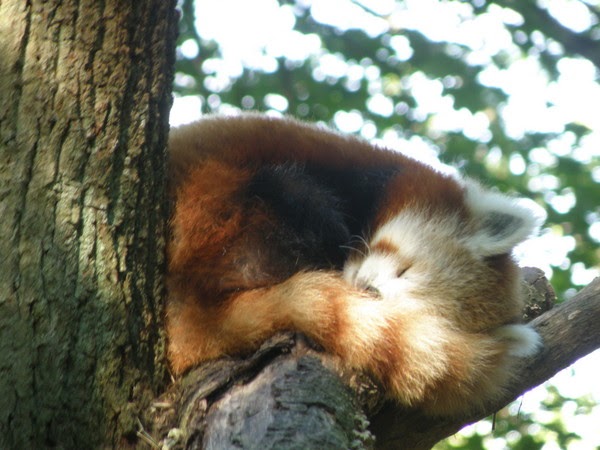
Tricky has spent a great deal of time up in the branches of the giant oak tree in her enclosure.  She came to the park from another facility about 3 weeks ago, and  unfortunately, I know the journey was fraught with traditional, stressful procedures, which make the readjustment period long and very hard on the animal.

Even if Tricky had been introduced to positive reinforcement training practices at her former facility, I know that the transport procedure was one in which trapping and crating were used.  It's unfortunate -and it certainly doesn't have to be done in such a manner.  The whole process of getting an animal to voluntarily go into her crate and be transported can be trained -it just takes staffing and time.  By tricking the animal into a crate, the end result is that one has to re-establish the animal / human bond of trust.

So, after spending a few days just quietly sitting in her enclosure and observing her reactions to my presence,  I felt that the more active training should be postponed for a bit -for two reasons: 1) to give her more time to adjust to her new home, and 2) because the facility here just informed me that a female companion for Tricky would be arriving in two days time ...yikes, the timing seems poor to me.  I'll wait until the dust settles! As far as I know,  learning -even when the most positive methods are used, inherently contains an element of stress.  One only has to look back to our own learning experiences to support this point.  I have to chuckle here a bit -because I can assure you that some lessons I learned were far more stressful than others!

Lesson learned:   
If I had to advocate for just one good argument as to 'why a wildlife facility should hire a professional trainer,' it would be "so that facilities could eradicate the older methods of animal husbandry and relocation practices that are still in abundant use today. 


Friday, May 27, 2011

'Love at First Bite'


Was it me? -or was it the apples?
Spending a little time training at the farm provides a nice contrast to working in the wildlife section of the park.  There is a calm routine to the animal's daily comings and goings, even now, during lambing season. 

Upon my arrival at the farm, I head into the kitchen to slice up some apples, pears, and carrots for the upcoming training session, which will involve a goat, 1 extremely large hog, and a friendly little female pig.  I take my bag of fruit, my target stick, and my clicker and go off to meet the head zookeeper.  First up is the goat, and the zookeeper would like me to try to teach him to pull a small cart.  I feel the need to explain that this will take some time, and I'll start by training some easy foundation behaviors first.  I won't ask an animal who has never been trained before to start off with complex behaviors.  It's much easier to teach them some simple behaviors, so they can  #1) get the idea that what they do brings about some pretty tasty treats, and #2) have a repertoire of about 5 behaviors that they absolutely "know" -this way, when we're learning more difficult behaviors, I know I can always shift gears if I need to, and pull up something the animal easily can do so he'll feel successful.
    I find Lena (the zookeeper) working near the pasture.  She points to a large group of white goats and says with a curious amount of certainty, "he's the white male over there."  
    
"Over there (?) ...ahh, that one,"  I say with false confidence as I casually inch closer to  seek a better alignment of her finger with the goat in question.

     "Yes, Mr. Bojangles ...he was neutered a few months ago." -And with that brief introduction, she then heads back to her work.

Identifying a white, neutered male among a herd of around 20 other white goats might not be a problem for some, but I'm somewhat green when it comes to white goats.  It's a simple explanation really.   I was raised in the Senoran Desert -a vast 'goatless' region in the American Southwest. 

Trying to size up the situation, I immediately subtract all the nursing nannies and their kids, which reduces my choices down to 4 goats.  As I walk through the gate, I calculate my chances of survival should I try to 'feel down-under' for recent signs of surgery.  One look at their curled horns, and I decide against it.

While I'm pondering my dilemma, I quickly am surrounded by a multitude of curious little goats who begin  nibbling at my shoestrings and pant legs.  Within seconds, they are trying to climb up my legs.
Varning!!  Cute, but trouble!

As I lean down to gently pry one from my body, several others become interested in chewing  my ponytail  -I'm rapidly losing control of the situation!

Just about the time I'm thinking of abandoning ship, the little ones scatter and I feel a gentle butt on my backside.  It's Bojangles to the rescue -or at least if it isn't, this goat will do!  A small piece of apple is all it takes for him to follow me into the training stall, and the rest, as they say, is history.

Now, Bojangles isn't too sure about that strange clicking sound -but the apples that follow seem to distract him nicely.  I muffle the clicker a bit with my hand and try again.  I'm clicking any movement towards a small piece of cardboard that has been placed on the floor of the stall.  My goal is to have him place all four of his feet on the cardboard.  On the first 2 clicks, he startles and backs away - I move back a bit, muffle the clicker by placing it inside my vest pocket and I wait for him to look in my direction again.  After a few more tries, he's got it.  However, as his enthusiasm builds, I quickly discover that I need to draw some boundaries here!  I step to one side of the cardboard station and sure enough, he comes to me instead of the station.  He waits in vain and looks up at me with those beautiful yellow eyes as if to say, "hey! what gives!"  It's no problem really - in training, the learner needs to make some errors in order to understand exactly what he needs to do in order to produce that little noise and the juicy apple.  My general rule is to allow no more than 2 errors before I resort back to those foundation behaviors and get a little success going again.  We spend about 20 minutes playing the clicker game together, and by the end of our session, he's learned both stationing, and targeting with his nose.  He's feeling a bit cocky ...for the first time in months!

I open the gate so Bojangles can rejoin his friends again, and then I gather up my gear.  As I begin to walk away, I glance back to the stall.  Such a face!  

  Bojangles is in love

Lesson learned:
No more ponytails when training the goats! 
Maybe I should also consider 'lesser value treats'...as this attraction is quite intense!

Thursday, May 26, 2011

Animals From Another Time


From the intern's cottage, it's a leisurely 20 minute walk down to the working farm, that is however, unless one takes the long way.  At first, I thought the long way would be a short cut, so I hopped over the old wooden fence that separates our cottage from the pastures and meadows where the sheep typically can be found grazing these days.  On the far side of the meadow, there is a slight opening in the underbrush -marking a path, which twists and turns through a forest of red pine trees, exposed roots, and lilly-of-the-valley that hug the edges of smooth-faced granite boulders.

Taking the long way home


Mid-way through the journey, the trees become so dense that the sun's light is nothing more than  thin shards of gold that  occasionally pierce through a background of dark, primeval green.  It doesn't take a great deal of imagination to feel as if you've just wandered into  Middle Earth, and in truth, there is an odd sense of timelessness.
Animal Tales

Stories from those who have passed this way before are etched in stone, and chapter by chapter they continue their tale until -as if by magic, you are standing once again in full sunlight at yet another meadow's edge.

Lesson learned:
Take the long way home ~ often!